
Le Temps des Hélices 2026 – A Spectacular Journey Through Aviation History | Rehearsel Day 22 May
➤ Scroll down to view the full photo gallery from Le Temps des Hélices 2026
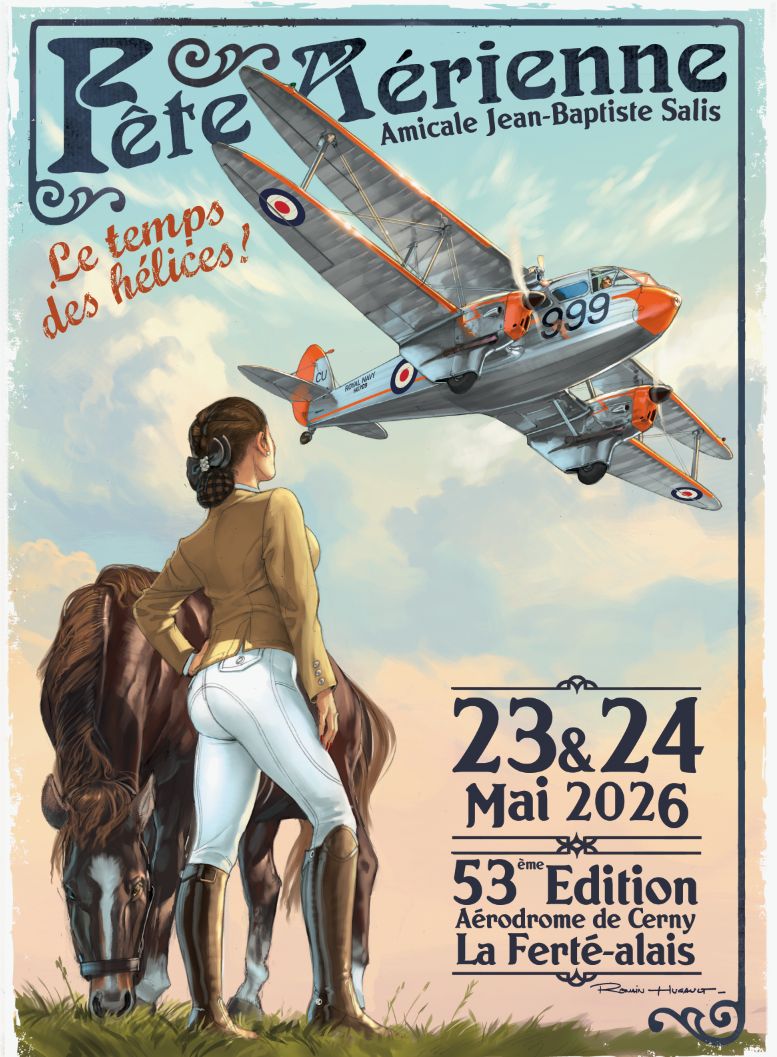
On 23 and 24 May 2026, the historic airfield of Cerny-La Ferté-Alais, south of Paris, once again became a meeting point for aviation enthusiasts during the 53rd edition of Le Temps des Hélices. Organised by the Amicale Jean-Baptiste Salis (AJBS), this renowned French airshow brought together historic aircraft, legendary warbirds, aerobatic teams and modern military aviation in a unique setting.
With its grass runway, historic surroundings and aircraft operating close to the spectators, La Ferté-Alais offers an atmosphere that is difficult to find at larger modern airshows. The event is not simply a collection of individual flying displays; it is a celebration of aviation history, presented through themed sequences that connect the pioneering days of flight with the aircraft of today.
1.From Aviation Pioneers to Modern Military Aircraft
The programme featured an impressive variety of aircraft representing more than a century of aviation development. Historic types such as the Blériot XI, Caudron C-109, Fokker Dr.I and SE5a recalled the early years of powered flight and the aerial combat of the First World War. The warbird displays brought some of aviation’s most recognisable aircraft into the spotlight. The Supermarine Spitfire and Messerschmitt Bf 109 represented the Second World War, while the Junkers Ju 52, Pilatus P-2 and Fieseler Fi 156 Storch demonstrated the diversity of historic military aviation.
The North American T-6 Texan and T-28 Trojan added another dimension to the programme, with the T-28S Fennec and North American OV-10 Bronco also appearing in the flying displays. These aircraft illustrated the transition from piston-powered military trainers to more specialised post-war aircraft. Modern French military aviation provided a striking contrast. The Patrouille de France demonstrated the precision of its Alpha Jet formation, while the Rafale Solo Display showcased the performance and manoeuvrability of the Dassault Rafale.
2.Renault Caudron C.460 Rafale Meets the Dassault Rafale
One of the most distinctive highlights was the combination of the historic Renault Caudron C.460 Rafale and the modern Dassault Rafale of the French Air Force. The C.460 was developed during the 1930s as a high-performance racing aircraft. Designed by Marcel Riffard, it represented the aerodynamic ambition of an era when aviation pioneers were pushing the boundaries of speed and aircraft design.
Its appearance alongside the modern Rafale created a remarkable visual connection between two very different generations of French aviation. Both aircraft reflect the pursuit of performance and aerodynamic efficiency, although they belong to entirely different technological eras. The presentation also complemented Renault’s role as the event’s guest of honour, celebrating the historic relationship between automotive engineering and aviation. The name Rafale, first associated with the Caudron racing aircraft, continues to connect the historic aircraft with Renault’s modern automotive range.
3. Recreating the Attack on Pearl Harbor
Another memorable feature was the reenactment of the Japanese attack on Pearl Harbor. More than ten North American T-6 Texans took part in the aerial sequence, accompanied by pyrotechnic effects on the ground. The combination of multiple aircraft, coordinated flying and simulated explosions created a dramatic historical scene. Rather than presenting the T-6s simply as individual aircraft, the display used them together to recreate the atmosphere of a wartime operation.
The T-6 Texan remains one of the most recognisable training aircraft of the Second World War era. Its versatility and distinctive appearance make it particularly well suited to this type of historical flying display.
4. Aerobatics, Formation Flying and Wingwalking
The programme also offered plenty of variety for fans of aerobatics and precision flying. The Patrouille Tranchant, flying the Fouga CM.170 Magister, brought classic French jet trainers into the spotlight. Their distinctive twin-engine configuration and characteristic V-tail make the Fouga instantly recognisable.
The Patrouille Aéroclub de France added another formation display, while individual aerobatic aircraft, including Extra 300-series aircraft and Pitts Specials, demonstrated the capabilities of purpose-built aerobatic machines. The 46 Aviation Wing Walker Team provided a different kind of spectacle with a Boeing-Stearman PT-13D Kaydet. Wingwalking combines the performance of a vintage biplane with the skill and precision of a performer working on the aircraft’s wings during flight. The programme also featured the Druine D.31 Turbulent display team and the Socata TB-30 Epsilon, adding further variety to the flying demonstrations.
5. Historic Transport Aircraft and Unusual Visitors
Transport and utility aircraft formed another important part of the event. The Junkers Ju 52, with its unmistakable corrugated-metal construction and three-engine configuration, represented an important chapter in early commercial and military transport aviation. The Douglas C-53D Skytrooper and Douglas C-47B Skytrain were also featured in the photographic coverage, highlighting the enduring legacy of the Douglas DC-3 family. These aircraft played a major role in military logistics and post-war civil aviation.
A particularly interesting participant was the ATR-72-600, also known as the ATR 72-212A. Its presence offered a contrast between historic aircraft and a modern regional turboprop airliner, demonstrating that aviation heritage and contemporary commercial aviation can share the same stage. Other aircraft photographed during the event included the Nord 1101 Noralpha, Nord 3202 and Pilatus P-2, as well as the North American OV-10B Bronco. Together, they represented the remarkable diversity of aircraft that can be found at La Ferté-Alais.
6. Preserving Aviation Heritage
Behind the event stands the Amicale Jean-Baptiste Salis, an organisation dedicated to preserving, restoring and maintaining historic aircraft in flying condition. Based at Cerny-La Ferté-Alais, AJBS works alongside other heritage organisations and private owners to keep historic aircraft operational. The collection at the Musée Volant Salis includes aircraft spanning the early twentieth century to more recent aviation history.
This preservation work is essential to the identity of Le Temps des Hélices. Seeing these aircraft fly allows visitors to appreciate not only their historical significance but also the engineering, restoration work and dedication required to keep them airworthy. The event provides a rare opportunity to see aircraft from different periods operating in the same environment, from early pioneering designs to wartime fighters, post-war trainers and modern military aircraft.
7. A Celebration of Aviation Past and Present
Le Temps des Hélices 2026 once again demonstrated why La Ferté-Alais holds such a special place on the European aviation calendar. Its combination of historic aircraft, dramatic themed displays, aerobatic performances and modern military aviation offers a distinctive alternative to conventional airshows. From the evocative pairing of the Caudron C.460 Rafale and the Dassault Rafale to the large-scale T-6 Texan reenactment, the event brought aviation history to life through the aircraft themselves.
For aviation photographers and enthusiasts, the historic grass airfield provides a particularly appealing setting. More than a flying display, Le Temps des Hélices is a celebration of the people, machines and passion that continue to keep aviation history alive.